
Community Forum Highlights Challenges to Health Care Access
PORTSMOUTH - For Greater Seacoast Community Health, delivering on its health-care mission means staying a step ahead in an uncertain and fast-changing environment. And it’s not alone.
“Now is a time of great confusion,” said Ally Mulligan, a Board member and patient of Greater Seacoast, explaining why the organization decided to host a Health Insights Forum on Nov. 19. “We thought that if we are confused as a Board, the whole community must be, and that Greater Seacoast could play a role in convening people to share what we understand to be true and to learn together.”
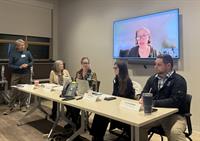
About 35 people participated in the forum, held at Greater Seacoast’s Portsmouth location, Families First Health & Support Center. They included representatives of the City of Portsmouth’s health department and library as well as nonprofit organizations including Seacoast Mental Health Center, Cornerstone VNA, AIDS Response Seacoast and the Foundation for Seacoast Health.
Georgia Maheras, who tracks national and state health-care policy for Bi-State Primary Care Association, highlighted uncertainty surrounding issues such as federal tax credits for Health Insurance Marketplace plans, the status of federal grants in light of changing Administration priorities, and changes to student-loan forgiveness for physicians and other professionals who take public-service jobs.
Greater Seacoast CEO Jocelyn Caple, MD, noted other challenges: the new prohibition on using federal dollars to serve some immigrants even though community health centers like Greater Seacoast have a mandate to provide care to all, and the likelihood that many people will lose their Medicaid coverage due to new work requirements. Even people who are in fact working or who have a legitimate exemption from the work requirement can find the need to document this a real roadblock, she said.
Mary Moynihan and Susan Turner, health insurance enrollment specialists at Greater Seacoast, noted the challenges of helping people enroll in or renew insurance plans on the federal Health Insurance Marketplace for 2026. With tax credits having been significantly reduced, many people can no longer afford the coverage or can afford only plans with extremely high deductibles and copays, they said.
With more of its patients likely becoming uninsured, Greater Seacoast is working hard to find ways to absorb the cost of providing care to all, regardless of their ability to pay or insurance status. Even then, notes Eric Oullette, a primary-care provider at Greater Seacoast, uninsured patients will have trouble acting on his recommendations when they need care outside of Greater Seacoast, such as specialty care, testing and hospital services.
Moderator Tim McNamara, a Greater Seacoast Board member, closed the discussion by noting that the current environment demands more coordinated communication and better public outreach. He said the organization hopes to hold future sessions and to encourage more community organizations and residents to attend.
Learn more about Greater Seacoast’s insurance-enrollment services at TinyURL.com/GSCHinsurance, or about the entire organization at GetCommunityHealth.org. Greater Seacoast Community Health offers a wide range of services, including primary care, pediatrics, prenatal care, dental care, behavioral health, mobile health care, medication-assisted recovery, family support and education programs, and pharmacy and lab services.
Greater Seacoast Community Health (d.b.a Families First Health & Support Center)
-
Margie Wachtel Communications Manager
- December 04, 2025
- (603) 422-8208
- Send Email
